Published November 3, 2026 · Last reviewed · 7 min read
Both are the same bond underneath
Most immigration bonds for release from detention are delivery bonds on ICE Form I-352. The bond guarantees that the released person will appear when ICE or the immigration court requires it. Whoever posts the bond is the obligor and takes on that responsibility. The form itself says the obligor may be an individual or entity that deposits a cash equivalent, or an acceptable surety company listed on the U.S. Treasury's Circular 570.
Cash bond: paying the full amount to ICE
With a cash bond, the obligor pays the entire bond amount to ICE. ICE's CeBONDS system lets people in the United States verify bond information and post cash bonds online. ICE lists U.S. citizens, lawful permanent residents, law firms, and nonprofit organizations as eligible to post a delivery bond through CeBONDS, and requires identity and status documents from the obligor.
The main advantage is that the money is generally returned to the obligor after the bond is cancelled, as long as the conditions were met. The main obstacles are that the family needs the full amount available at once, and someone with eligible status has to be the obligor.
- Keep the bond receipt and every ICE document. They are needed for the refund later.
- If the obligor moves, ICE's bond form requires them to file an Obligor Change of Address (Form I-333).
- Check posting hours and payment instructions on ice.gov before sending money.
Surety bond: posting through a licensed agent
With a surety bond, an insurance company authorized for federal bonds guarantees the full amount to ICE, and a licensed agent signs as co-obligor. Instead of paying the full bond, the family pays the agent a premium and usually signs an agreement and provides collateral.
The premium is generally earned when the bond is posted and is typically non-refundable. Collateral is handled under a separate written agreement and is returned according to that agreement once the bond is cancelled. Premiums and collateral depend on the case, so ask for every number in writing and read the agreement before signing.
Side by side
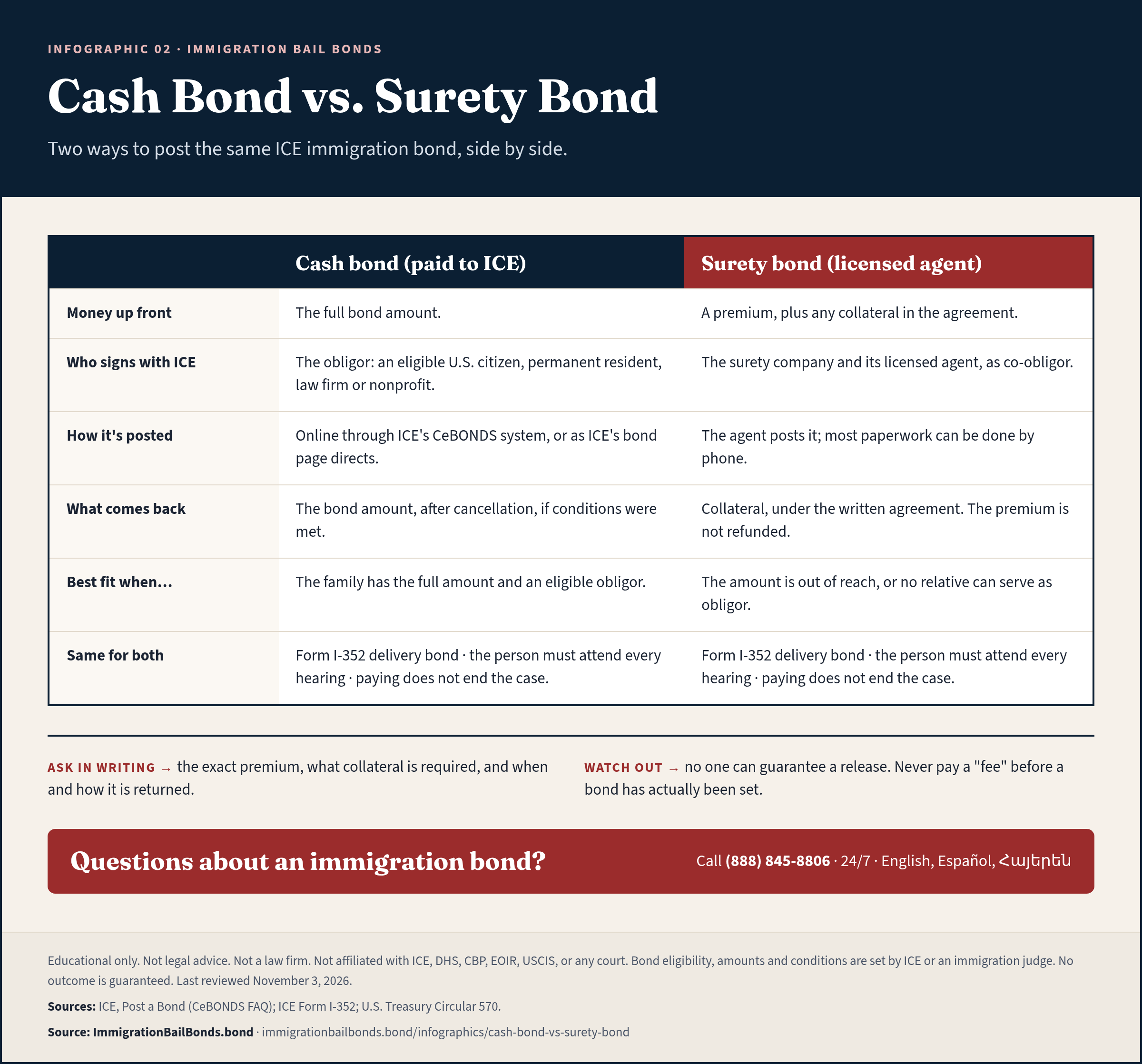
- Money up front: cash bond requires the full amount; surety bond requires a premium plus any collateral.
- Who signs with ICE: cash bond, the family member or organization; surety bond, the insurance company and its agent, with the family signing an agreement with the agent.
- What comes back: cash bond, the bond amount after cancellation if conditions were met; surety bond, collateral under the agreement, but not the premium.
- Who can do it: cash bond requires an eligible obligor; a surety bond can help families where no relative can serve as obligor.
Which is right for your family?
If your family has the full amount available and an eligible obligor, a cash bond posted directly with ICE costs nothing beyond the bond itself. If the amount is out of reach, or no one can act as obligor, a surety bond may be the practical path. Either way, nothing can be posted until a bond has actually been set, and paying a bond does not end the immigration case.
Be careful with anyone who promises release, asks for large fees before a bond exists, or pressures you to sign without reading. A licensed agent should explain the premium, collateral, and your obligations clearly before you commit.
Sources
Opens in a new tab Official procedures change; check the source before acting.