Published November 3, 2026 · Last reviewed · 6 min read
What the locator is, and what it covers
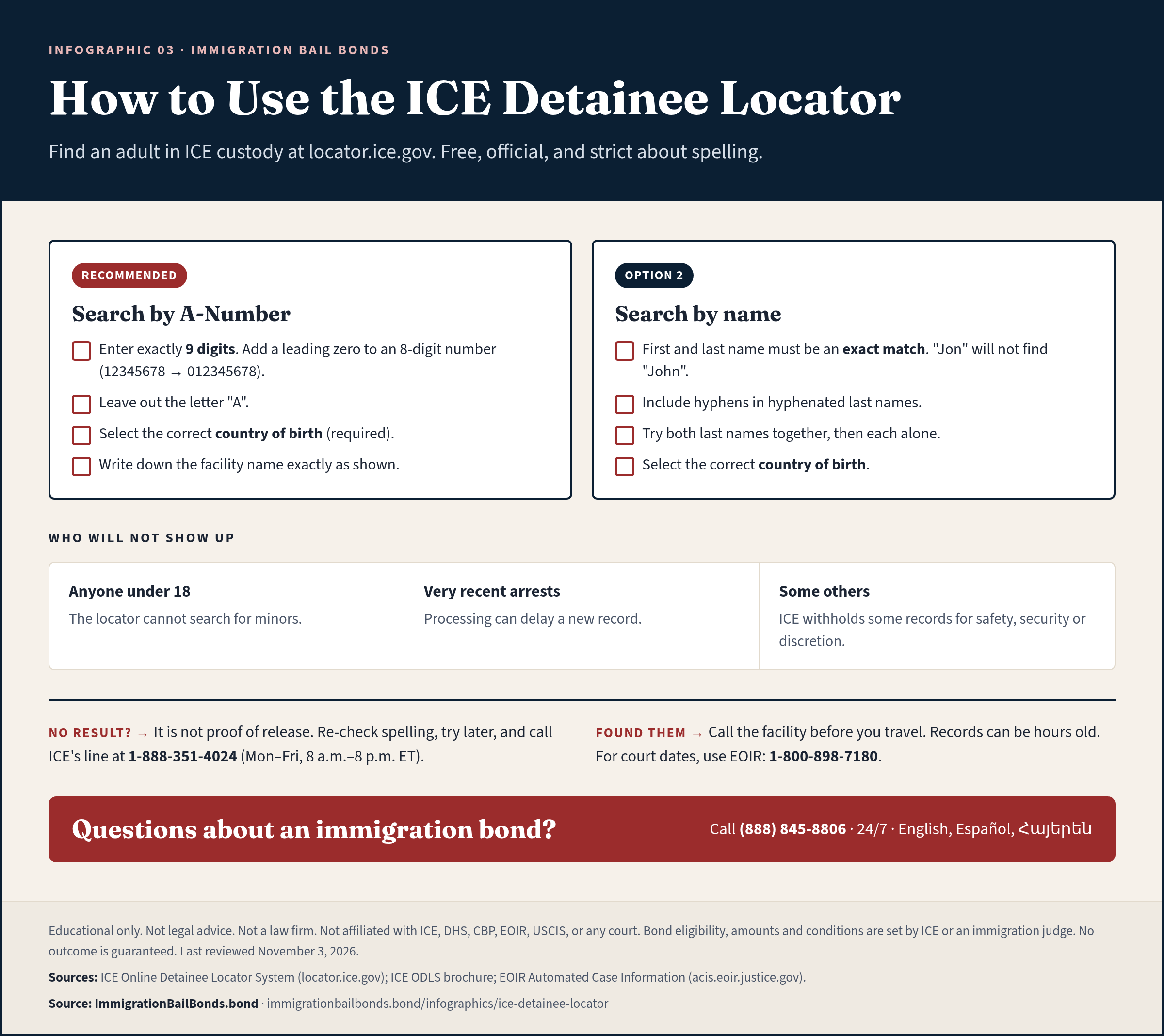
The Online Detainee Locator System (ODLS) is ICE's public search tool at locator.ice.gov. ICE says it can locate a person who is currently in ICE custody, or who has been in U.S. Customs and Border Protection custody for more than 48 hours. When it finds someone, it shows the facility name and contact information for the facility and the responsible ICE office.
It does not show everyone. ICE states that the locator cannot search for anyone under 18, that some people may not appear right after they are detained because of processing time, and that safety, security, and agency discretion keep some people out of the results.
Option 1: Search by A-Number (recommended)
If you know the person's A-Number (Alien Registration Number), ICE recommends this search. The A-Number appears on most immigration paperwork, such as notices from DHS or the immigration court.
- 1Open locator.ice.gov and choose the A-Number search.
- 2Enter the A-Number as exactly nine digits. If it has eight digits, add a zero at the beginning (for example, 12345678 becomes 012345678). Leave out the letter A.
- 3Select the person's country of birth. This is required and must be correct.
- 4Run the search and write down the facility name exactly as it appears.
Option 2: Search by name and country of birth
Without an A-Number, you can search by biographical information. ICE requires an exact match on first and last name: 'John Doe' will not find 'Jon Doe' or 'John Doe-Smith'. Hyphenated last names must include the hyphen.
- Try the name as it appears on the person's passport or national ID, not a nickname.
- For people with two last names, try both surnames together, with and without a hyphen, and then each surname alone.
- Check accents and spelling variations if the first search fails.
- Select the correct country of birth, and add date of birth if the form asks for it.
If the search finds nothing
An empty result is not proof that a person has been released or deported. ICE says the system can be several hours behind after a transfer, release, or removal, and new arrests can take time to appear. In September 2026, the Associated Press reported that people with final orders of removal had been taken out of public locator results, so a missing record is even less conclusive than before.
If the search fails, re-check spelling and the country of birth, try again later in the day, and call ICE's Detention Reporting and Information Line at 1-888-351-4024. ICE lists its hours as Monday to Friday, 8 a.m. to 8 p.m. Eastern Time, excluding holidays, with Spanish-speaking operators available. You can also contact the ICE field office that covers the place where the person was arrested.
After you find them
Call the facility to confirm the person is there before you travel, because the locator can be hours old and people are moved. If you plan to visit, ask about visiting rules and bring government-issued photo ID. For court dates, use EOIR's Automated Case Information at acis.eoir.justice.gov or call 1-800-898-7180; the locator does not show hearings.
Write down the full name, A-Number, country of birth, facility name, and anything ICE tells you about a bond. Those details are exactly what a bond agent needs on the first call.
Sources
Opens in a new tab Official procedures change; check the source before acting.