Published November 3, 2026 · Last reviewed · 6 min read
What changed in 2025
For decades, people who entered the U.S. without inspection and were later arrested inside the country were generally detained under a law (8 U.S.C. § 1226(a)) that allows an immigration judge to set bond. In July 2025, DHS adopted a new position: that these people are 'applicants for admission' subject to mandatory detention under 8 U.S.C. § 1225(b)(2)(A), with no bond hearing.
On September 5, 2025, the Board of Immigration Appeals adopted that reading in Matter of Yajure Hurtado, 29 I&N Dec. 216 (BIA 2025). As a result, many immigration judges began saying they had no authority to hold bond hearings for people in that situation.
Federal appeals courts have split
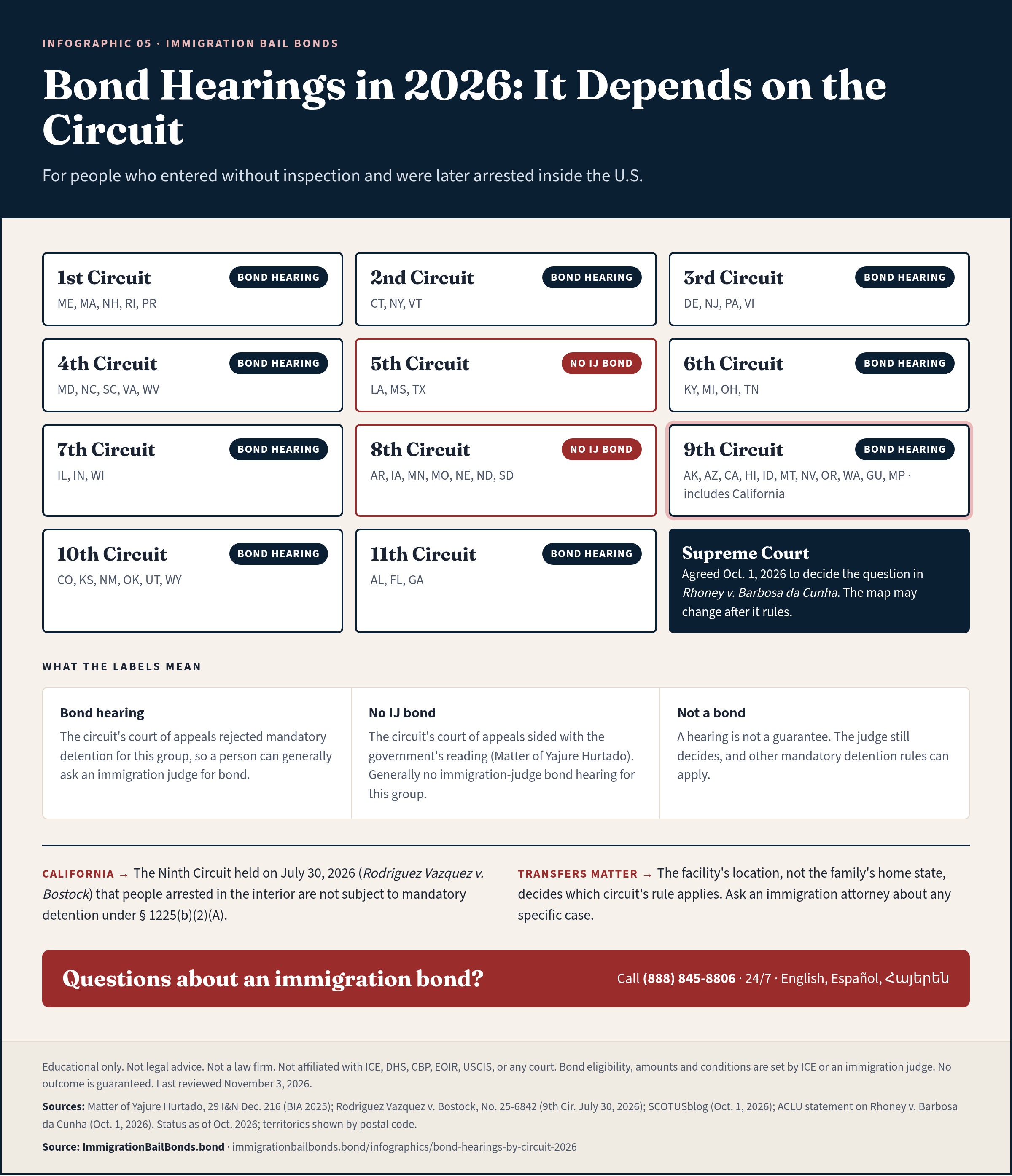
Federal courts reviewing detention challenges reached different conclusions. The Fifth Circuit (Texas, Louisiana, Mississippi) and the Eighth Circuit have sided with the government's reading. Most other circuits that have ruled, including the Second, Ninth, and Tenth, have rejected it and held that people arrested in the interior are generally detained under § 1226(a), which allows a bond hearing.
Because the rule now depends on the circuit where the facility is located, a transfer from one state to another can change whether a bond hearing is available.
What it means in California
California is in the Ninth Circuit. On July 30, 2026, in Rodriguez Vazquez v. Bostock (No. 25-6842), the Ninth Circuit held in a published opinion that people present without admission who are apprehended in the interior are not subject to mandatory detention under § 1225(b)(2)(A). For many people detained in California who entered without inspection and were arrested inside the country, that means they can ask an immigration judge for bond.
A bond hearing is not a bond. The judge still decides whether to set bond and how much, and other mandatory detention rules, such as those tied to certain criminal charges or convictions, can still apply. The person's specific history matters.
The Supreme Court will decide
On October 1, 2026, the U.S. Supreme Court agreed to hear Rhoney v. Barbosa da Cunha, which asks whether § 1225(b)(2)(A) requires detention without a bond hearing for people who entered without admission and were later arrested inside the U.S. Argument is expected during the 2026-27 term. Until the Court rules, current circuit law applies, and the national picture could change after the decision.
What families can do now
- Find out exactly where the person is held, since the facility's location can decide which rules apply.
- Ask an immigration attorney whether the person can request a bond hearing, and whether a federal habeas petition makes sense if bond is refused for lack of jurisdiction.
- If a bond is set, have the obligor and payment plan ready so it can be posted quickly.
- Re-check this page and official sources; we update it when major rulings come out.
Sources
- Ninth Circuit opinion, Rodriguez Vazquez v. Bostock (July 30, 2026)
- SCOTUSblog: Court agrees to hear immigration detention case (Oct. 1, 2026)
- Matter of Yajure Hurtado, 29 I&N Dec. 216 (BIA 2025)
Opens in a new tab Official procedures change; check the source before acting.